Day Twenty Five
Literacy
I read a good article
yesterday on the Hybrid
Pedagogy website. The article
entitled “Wither
the Digital Humanities” discussed a number of issues, but I was
particularly struck by the author’s attitude to various types of reading. There was a reference to Katherine Hayles’s How
We Think: Digital Media and Contemporary Technogenesis and I tended to
agree with the proposition that “accommodating
various types of reading can benefit students, instead of assuming deep reading
as the only reading that matters.”
There was also another
line in the article that really struck a chord with me as it aligned very much
with some conclusions that I have been coming to recently.
“We cannot naively dismiss the cultural impact
of the digital on reading and writing without compromising our ability to
cultivate a reflective, critical sensibility to both appreciate and nourish,
while questioning and containing, the power of tradition, common sense, and
authority to govern our lives. Put simply, public literacy — the cornerstone of
a democracy — is at stake.”
“Put simply, public literacy —
the cornerstone of a democracy — is at stake.”
I think many of us are
growing increasingly concerned at events in the world. Indeed I do hope that you are. The situation in the Middle East, in Iraq and
Syria. The impact that has had on mass migration. The shift towards nationalism
in politics in many countries and now what we see happening in the United
States. If you watch too much news it
can feel as if it is spiraling out of control.
Perhaps it is doing exactly that and people felt the same in the 1930s?
Public literacy. What does it mean to be literate?
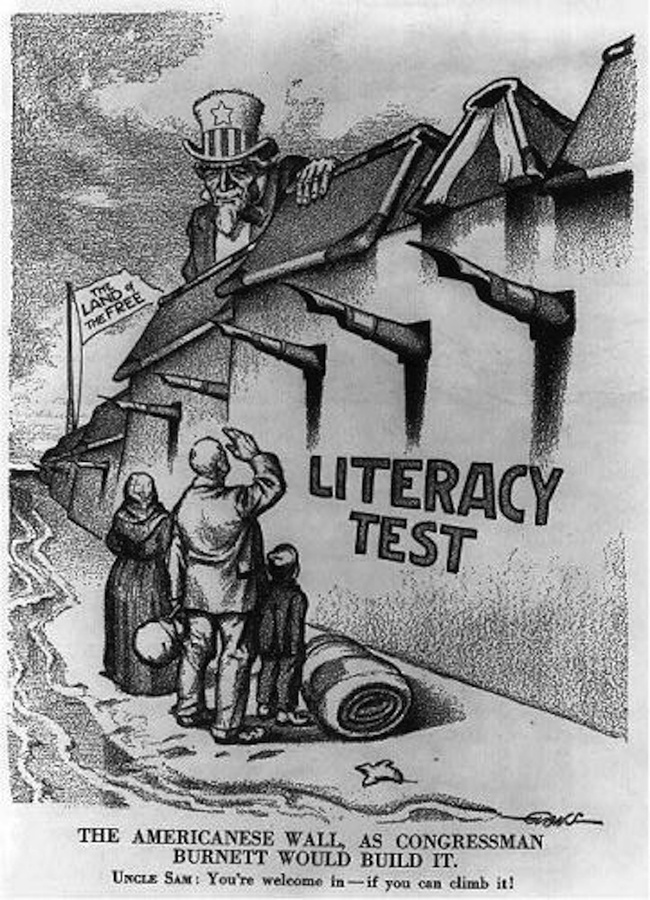 |
| See http://www.theatlantic.com/national/archive/2011/11/racist-anti-immigrant-cartoons-from-the-turn-of-the-20th-century/383248/ |
I think that it of
course includes that ability to read and write, listen and speak. It also includes a literacy of numerical
functions and understanding of mathematics.
As I travel around the online and e-learning world, both virtually and
literally, I hear the many calls for digital literacy and join that call
myself. (Not that I am an unthinking advocate of all things Ed Tech, but that
is another post).
However it strikes me
that as education in many countries has become increasingly focused on the
economic, that is to say employability and being a productive component of a
workforce, we have neglected other important literacies. I am
not arguing that employability is not important, what I am saying is that it should
not be the only component. The focus on
education as only preparation for employment has impacted in many ways,
including, but not limited to, a drive towards ‘credentialism’ and surface
learning.
My own view is that
other literacies are important and are being neglected. These include economic and financial literacy. After all, in a democracy you have a duty and
responsibility to cast a vote, but if you do not understand even basic
principles of economics, finance or politics, how can you do that in an
informed way?
I have heard people
who have studied business and entrepreneurship, without any real understanding
of economic policies and the way national and international economies
work. The metaphor they are fed by the
media and politicians of the ‘household and commercial business’ are false
narratives. They make sense to those without
a real understanding, but the metaphor is incorrect. I am not talking about disagreeing over policies,
I am talking about being unable to even have that debate. If I were a conspiracy theorist I might even
believe that there was a plan afoot to misdirect and mislead even those who do
study these subjects when one looks at the curriculum that is taught.
I would also add a
literacy of history and politics to my list.
I do not just mean being able to recall dates and events, I mean
understanding why and how things happened and what the impact is on the world
we live in today. I know that this is
done by some teachers and some systems, but it is too often neglected. This is the problem in countries where the curriculum
for the 14 – 18 age groups becomes increasing narrow, so that by 16 – 18 you
end up studying only 3 or 4 subjects seriously at a rigorous level.
Many of the problems
we see in the world today have a basis in fear. That fear is used by politicians
and the media. It is a fear of an
uncertain economic future, fear of people different. People see a world that is stuck in
stagnation with no end in sight, in fact a situation that may well get very
much worse and they want to blame someone and raise the drawbridge and hunker
down, with a gun.
For those interested I
recommend this
was also a very interesting article about how cognitive science and linguistics
explains the situation in USA.
…
You may have spotted
that nowhere do I mention the “man who shall not be named” in the USA. This is because every time we use his name in
this virtual world we contribute to a narrative about him and whether it is
good or bad, the narrative helps him and he gains strength.
…
A very Finnish Sunday
evening in this household, with a family sauna and the Finnish sausages and ice-cream
for dessert. So ends the weekend. Goodnight and thanks for still being here
after more than three weeks.

Another interesting post. On a topic we briefly discussed a couple weeks ago. Can you give us a few names of authors on alternative economics?
ReplyDeleteGreat question Slowbow -
ReplyDeleteOK, off the top of my head -
Joseph Stiglitz.
Umair Haque - his website is good, in Economics look at Betterness and A New Capitalist Manifesto. His critique of both right and left often strick a chord with me.
Thomas Piketty - though even I have not yet managed to tackle Capital in the 21st Century (I just got it as an audible book so perhaps that will help). His much shorter book on ineqaulity is a more reeadable length.
Chomsky - well of course.
The film - The Four Horseman will give you a lot of links and there is a free PDF of the the book that goes with the film.
The people behind Four Horseman run a website called Renegade Inc and they put out some good stuff.
That will do for a start and there are aspects here that I would prefer to discuss in a private message.
By the way - I read both sides. I think I once shocked Crane because he saw that I owned not only Atlas Shrugged by Rand but also Hayek's Road to Serfdom. My view is that you have to know both sides - well I do not really see it as both sides, I see more of a continuum.
Cheers
Munki
Thanks Mark! Now all I have to do is make the time to read...
ReplyDeleteI forgot a few as well, like - Michael J Sandel - 'What money can't buy' is quite good on free market economy versus free market society.
ReplyDeleteI am sorry there is a rather left thinking thread in the above and in fact I can be as critical of the left as I am of the right, though Umair Haque does that best of all. His essay on the rise of fascism is very good in my opinion.
https://medium.com/leadership-in-the-age-of-rage/why-fascism-is-rising-again-and-what-you-can-learn-from-it-d5b853a7dccc#.dj8k18ep0
Best